Timeline
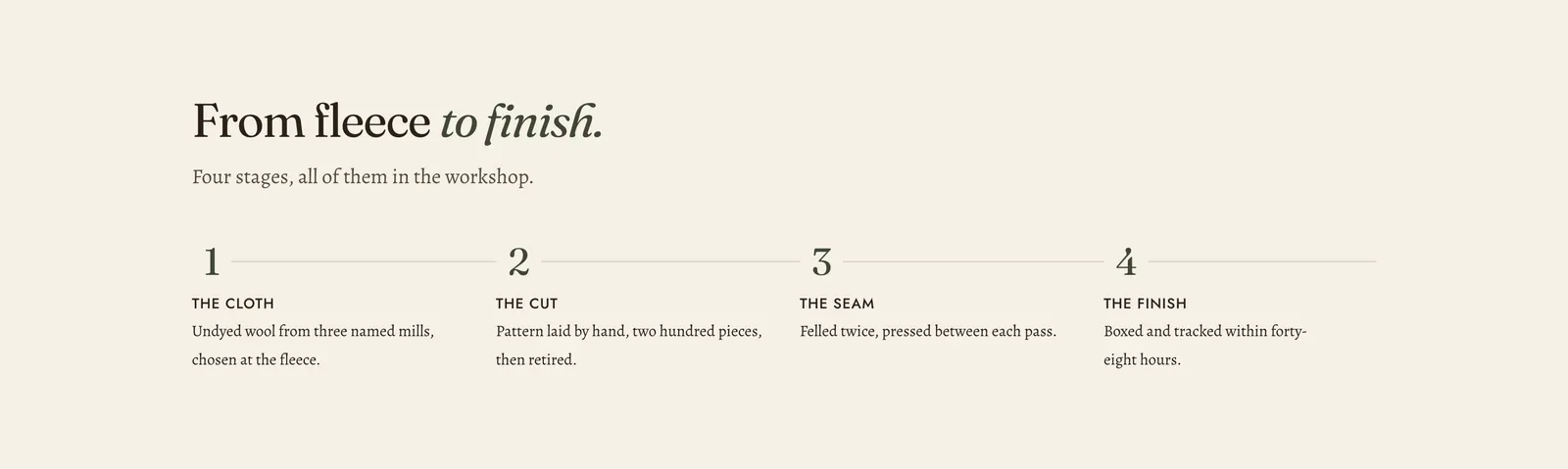
A sequence along a drawn line. The section carries three kinds of block, and the one you choose decides what the line means.
What it does: Puts things in order, visibly. A process, a history, or the stage an order is at are all the same shape, so they are all the same section.
The three block types:
| Block | The line means | Use it for |
|---|---|---|
| Step | An order of operations | How something is made: cloth, cut, seam, finish |
| Milestone | Time | A house history: 2013, 2017, 2021 |
| Stage | Progress, with a current position | Where an order or a made-to-order piece has got to |
Key settings (in the section’s settings):
| Setting | What it does | Default |
|---|---|---|
| Color scheme | Section colors. | scheme-paper |
| Heading width | Narrow, Normal, Wide, or Full width. | Wide |
| Heading alignment | Left, center, or right. | Left |
| Subheading | An optional small label above the heading. | Empty |
| Heading | The headline. Italicize a word to set it in the emphasis font. | ”From fleece to finish.” |
| Intro text | A line under it. | ”Four stages, all of them in the workshop.” |
| Layout | Row (desktop) runs the line across the page. Stacked runs it down. Phones always stack. | Row (desktop) |
The section also carries a Section spacing group. Pick a Device of Desktop or Mobile, then set Top and Bottom.
Blocks: up to 6 between them.
| Step setting | What it does | Default |
|---|---|---|
| Heading | The step’s name. Steps are numbered automatically, in block order. | ”The cloth” |
| Text | A line under it. | ”Undyed wool from three named mills, chosen at the fleece.” |
| Milestone setting | What it does | Default |
|---|---|---|
| Year | The date marker. Plain text, so “2013”, “Spring 2019” and “Since 1974” all work. | ”2013” |
| Note | What happened. | ”Two looms in a Porto workshop, the first run of two hundred.” |
| Stage setting | What it does | Default |
|---|---|---|
| Type | Done, Active, or Next. The line is drawn solid up to the active stage and faint after it. | Next |
| Label | The stage’s name. | ”Pressed” |
| Note | A line under it. | ”Steamed, inspected, and folded into tissue by hand.” |
When to use it: Use it on an About page, a made-to-order page, or a craft story. For stages that each need a picture, use Media row or Slideshow tabs. For chapters told at full-screen scale, use Hero scroll sequence.
Related: Media row · Slideshow tabs · Hero scroll sequence · Lapels support replies within 12 hours.